About Janus...
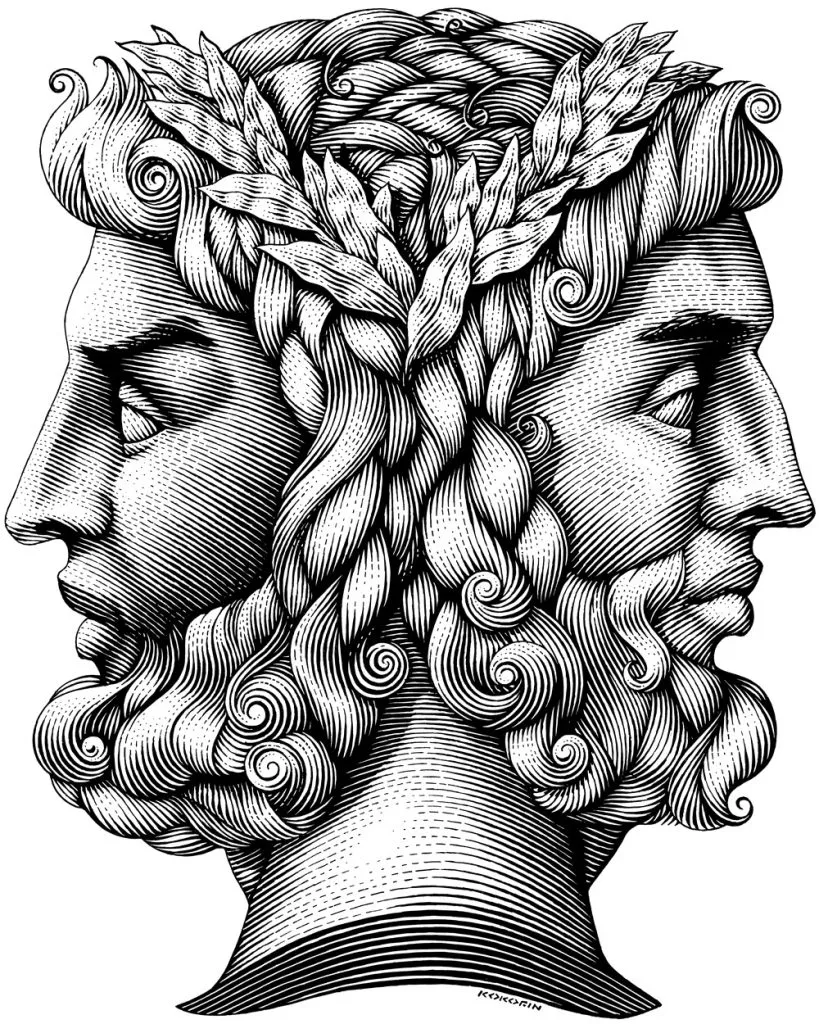
I want to tell you something about Janus, one of those old figures from Roman mythology who still feels strangely close to us.
He is usually linked with beginnings, change and the passing of time. I think that is why he remains so memorable. He stands at the threshold of things. He belongs to that quiet moment when one period ends and another begins.
His name is connected with the Latin word ianua, meaning door. He stands where something opens. He marks the crossing into what comes next. Even the month of January was named after him, since it opens the year and leads us into a new cycle.
The Romans imagined him with two faces, each looking in a different direction. One turns back, the other looks ahead. Because of this, Janus came to symbolize the strange human position between memory and expectation. We are always doing the same. Part of us remains with what has already happened, while another part moves toward what has not yet come. That is why Janus feels less like a distant myth and more like a reflection of our own condition.
He is also interesting because he had no true Greek counterpart. In the Roman world, that gave him a special place. He was not remembered as a god of great force or dramatic heroic acts. His importance came from something quieter. Saturn is said to have given him the power to govern passages and moments of transition. That alone made him significant, because so much in life depends on crossings...
Some stories even say that Janus opened the gates of heaven in the morning so the sun could rise, and closed them again in the evening when light disappeared. I like that image very much. It gives him a calm and almost invisible power. He does not rule through noise. He rules through openings and endings and perhaps that is closer to real life than the loud power we usually admire.
This is also why Janus can be read as more than a mythological figure. He is a philosophical image. A figure with two faces easily reminds us of the limits of human thought, of the fact that we are always looking both ways. In that sense, it is not surprising that he has been used as a metaphor when thinking about Kant and his famous sentence: “I had to deny knowledge in order to make room for faith.” Kant was trying to show that human reason has its limits, and that not everything can be fully reached by knowledge alone. In a way, that too is a threshold. One door closes, another opens.
And perhaps that is why he still matters. He reminds us that life is made of passages. We are never standing still for long. We are always leaving something behind, always stepping into something else, even when we do not yet have the words for it.